

Procedure for pre-lodged standard customs declarations for export
A customs declaration should be submitted to Swedish Customs when goods are being exported to countries outside the EU. One option is to pre-lodge a customs declaration.
The image below describes how to pre-lodge a standard customs declaration for export. The information is exchanged in separate messages. Under the image, you can read descriptions of what happens in each step.
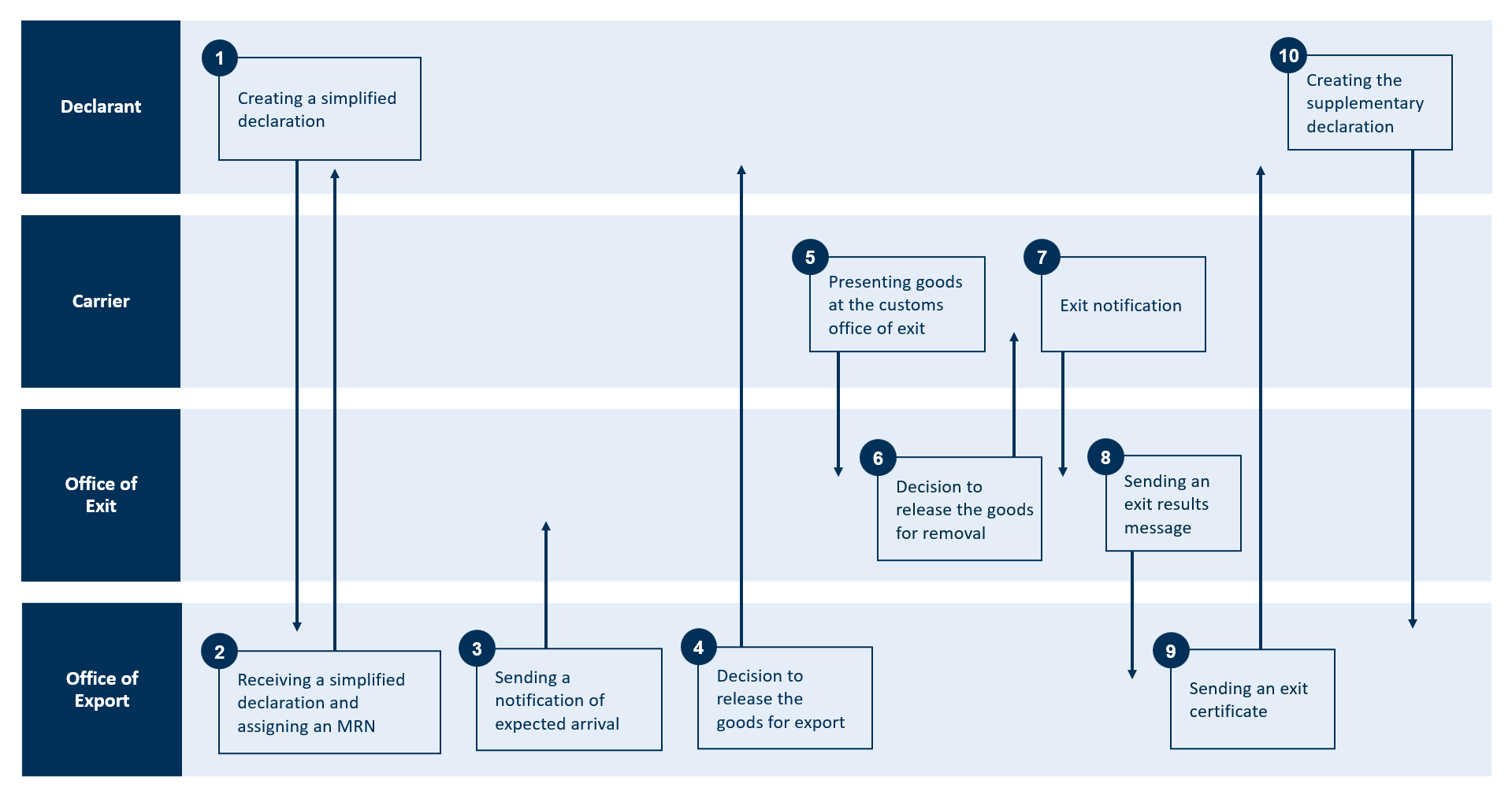 Zoom image
Klicka på bilden för att se den i större format
1. A pre-lodged standard customs declaration is created
The declarant completes a pre-lodged standard customs declaration and sends it digitally to Swedish Customs in message IE515, declaration type D. The customs declaration then contains an LRN (Local Reference Number).
A declarant may also engage an representative who will handle their communications with Swedish Customs. The representative acts on behalf of the declarant.
2. Presentation notification to the customs office of export for goods in a pre-lodged standard customs declaration
The declarant presents the goods to customs in message IE511 in order to have the goods released for the export customs procedure.
The person submitting the IE511 must be the same as the person who submitted the pre-lodged standard customs declaration (IE515).
When the IE511 message is submitted, the goods must be at an approved or designated place for export and available for inspection if required.
The message must be submitted within 30 days of the pre-lodged standard customs declaration being received by Swedish Customs, otherwise the declaration will be automatically cancelled.
The information to be included in the IE511 presentation notification is set out in Annex Q2 of the technical specifications for export and removal, DDNXA 5.15.2.
Technical specifications for export and removal (SCTS-AES) (in Swedish)
For further information on the details to be included in the data elements, please refer to the guidance on completing the standard customs declaration.
Declaration guide for standard customs declarations for export (in Swedish)
3. Receiving the standard customs declaration and assigning an MRN
The customs office of export receives the standard customs declaration and verifies that the information is correctly entered.
A case is created at the customs office of export, and the customs declaration is assigned an MRN.
The customs office of export sends the MRN to the declarant in message IE528. The customs declaration is now ‘Approved’.
4. Sending a notification of expected arrival
The customs office of export sends information about the expected arrival in message IE501 to the customs office of exit indicated in the customs declaration.
5. Decision to release the goods for export
The customs office of export will verify the correctness of the information in the customs declaration and decide whether the goods may be released. The decision to release the goods for export is sent from the customs office of export to the declarant in message IE529.
Now the goods can be loaded onto the means of transport and the goods can begin their journey to the customs office of exit.
6. Presenting goods at the office of exit
When goods arrive at the customs office of exit, the carrier presents the goods to the customs office of exit in message IE507. The notification refers to the MRN of the customs declaration.
7. Decision to release the goods for removal
The customs office of exit sends a decision to the carrier that the goods have been released for removal in message IE525. The goods may now exit the customs territory of the EU.
8. Exit notification
When the goods have left the customs territory of the EU, the carrier must notify the customs office of exit that the goods have been removed. This is done with message IE590.
9. Sending an exit results message
Once the customs office of exit has received the information that the goods have left the Union, the customs office of exit creates an exit result which is sent to the customs office of export in message IE518.
10. Sending an exit certificate
The customs office of export issues an exit certificate and sends it to the declarant in message IE599.