

Procedure for transit declarations – standard procedure
Here you can read about the process when submitting a transit declaration under the standard procedure.
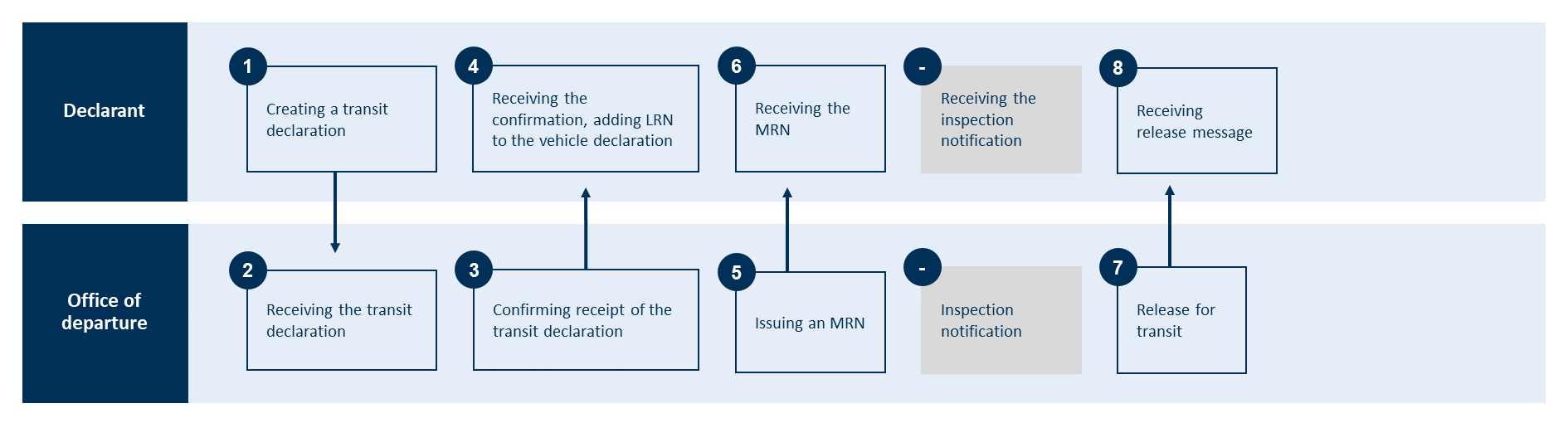
The image below illustrates the process of submitting a transit declaration using the standard procedure. Under the image, you can read descriptions of what happens in each step.
 Zoom image
Click on the image to enlarge
1. Creating a transit declaration
The declarant prepares a transit declaration and submits it digitally to Swedish Customs.
A declarant may also appoint an agent, who will handle their communications with Swedish Customs. The agent acts on behalf of the declarant.
2. Receiving the transit declaration
Swedish Customs receives the transit declaration and verifies that the information is correctly entered.
- In the event of errors, the customs declaration will be rejected. A message will be sent to inform the declarant that the transit declaration cannot be processed.
- If the information is correct, a message is sent to the declarant confirming receipt of the transit declaration.
In the next step, the system verifies the information.
- If there are any errors in this information, a message will be sent to inform the declarant of the identified errors. The declarant will be given an opportunity to amend the errors and re-submit the transit declaration.
3. Confirming receipt of the transit declaration
If the information is correct, a message will be sent to inform the declarant that the transit declaration has been received.
4. Receiving the confirmation, adding LRN to the vehicle declaration
The declarant receives the message, adds the LRN number to the vehicle declaration and requests to start the transit procedure at the declared customs office of departure.
If the transit contains an export declaration, the MRN is automatically assigned already at this stage.
5. Issuing an MRN (Master Reference Number)
The driver enters the customs office and presents the reference number (LRN or MRN) of the transit operation. A customs officer approves the case.
6. Receiving the MRN (Master Reference Number)
The declarant receives the MRN.
– Inspection notification
The declaration will be risk assessed. If the level of risk is deemed to be high, a message is sent to the declarant informing him/her that the consignment has been selected for inspection. The customs officer may also decide that an inspection is required and issue an inspection notification.
– Receiving the inspection notification
The declarant receives the message.
7. Release for transit
If no inspection is carried out, the applicable guarantee amount is reserved against the declared guarantee.
The customs officer sets a time limit for the transit movement and a message of release for transit is sent. The transport starts.
8. Receiving release message
The declarant receives the release notification.