

Tullverket

Procedure for centralised clearance – Simplified declaration

Herer you can read about how it works when you use centralised customs clearance and lodge a simplified customs declaration with Swedish Customs.

Those who have authorisation for centralised clearance in Sweden send their customs declarations to Swedish Customs (Supervising Customs Office, SCO) for goods entering another Member State (Presentation Customs Office, PCO). Find out more about applying for authorisation for centralised customs clearance on the Centralised customs clearance, import (CCI) page.

A declarant with an authorisation for centralised clearance can also use a customs representative for their contacts and communication with Swedish Customs. In this case, the customs representative acts on behalf of the declarant as a direct customs representative. In the case of indirect representation, it is the customs representative who must have the authorisation for centralised clearance.

An authorisation is required if the declarant wants to use simplified declarations as part of CCI.

In the description below, it is stated that Swedish Customs will communicate with the declarant, regardless of whether the communication takes place directly with the declarant or via their representative.

A description of each role can be found on the page:
Zoom image

Click on the image to enlarge.

Process description

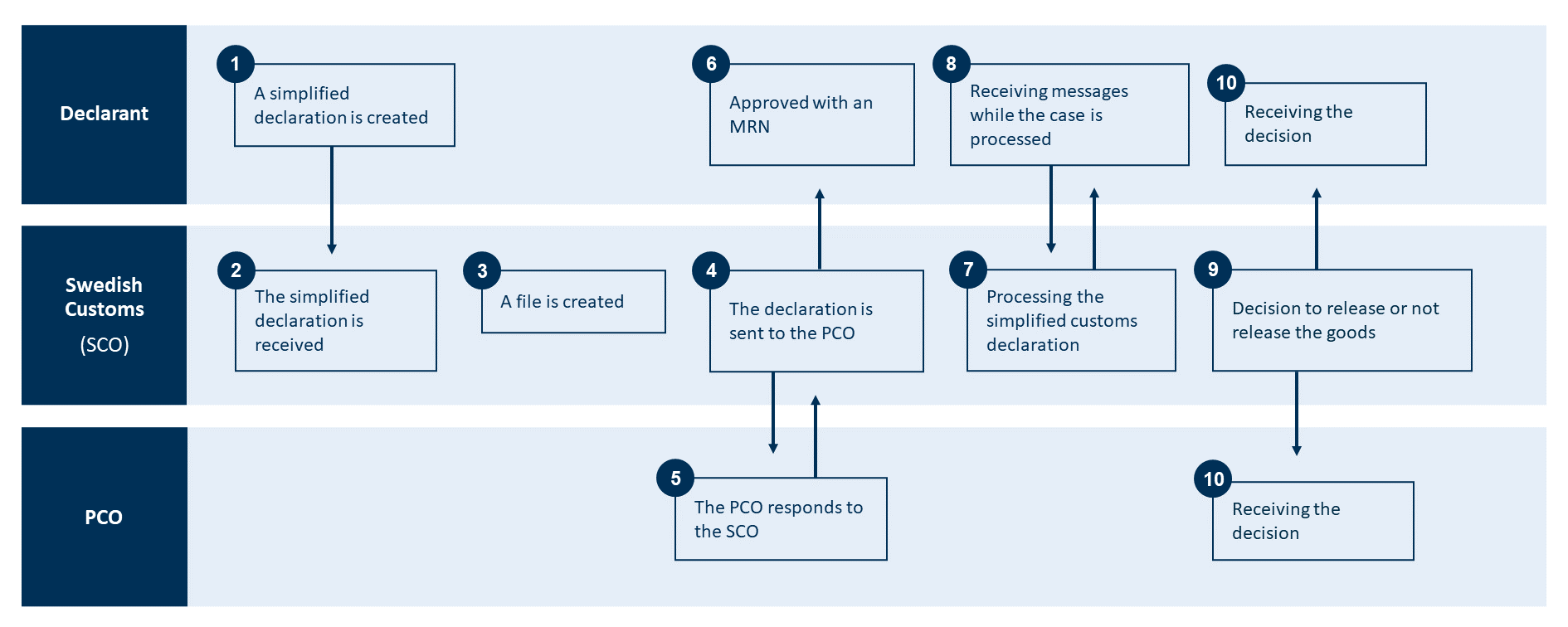
When using a simplified declaration for centralised customs clearance for goods from countries outside of the EU you should always lodge a customs declaration with Swedish Customs (SCO). The goods will then enter the EU in another Member State (PCO).

The declarant indicated in the customs declaration makes out a simplified declaration and submits it digitaly to Swedish Customs.

The customs declaration should contain a Local Reference Number (LRN)

The Swedish Customs receives the standard customs declaration and verifies that the information is correctly entered.

  • In the event of errors, the customs declaration will be stopped. A message will be sent to inform the declarant that the transit declaration cannot be processed. The declarant will be given an opportunity to amend the errors and re-submit the customs declaration.
  • If the information is correct, a message will be sent to the information provider to inform the declarant that the transit declaration has been received.

In the next step, the system will cross-check the information against TARIC and applicable authorisations.

  • If any of these entries are incorrect, for example, if a commodity code that does not exist in TARIC is used, a message will be sent in the customs declaration to inform the declarant of errors (received with errors). The declarant will be given an opportunity to amend the errors and re-submit the customs declaration.

A file will now be created with Swedish Customs

The information in the customs declaration will be sent to the PCO, which will also verify the information.

Once the PCO has verified the information in the declaration, they will send a response to the SCO.

If no errors are found in the above checks at the SCO and PCO, an MRN is assigned to the customs declaration. The MRN number will be included in the confirmation message to the declarant. The status Lodged and Approved will also be included in this message.

If the customs declaration is pre-lodged, this is the point where the procedure merges with the procedure for simplified declarations.

A. SCO
The Swedish Customs (SCO) will now verify that the information in the customs declaration is correct and can form the basis of decision in the matter. They will then forward the information in the declaration in the declaration to the PCO.

B. PCO
The PCO will receive the information in the customs declaration, verify it, and notify the SCO.

The declarant will receive any digital messages sent by Swedish Customs to request supporting documents and inform that an examination of the goods will be conducted.

Supporting documents should be submitted via Swedish Customs’ online service Uppladdning av handling (uploading documents). A link to this online service is included in the message; however, your company needs access to the online services.

Once any necessary examinations have concluded, the declarant will be notified of the outcome of the examination.

Swedish Customs (SCO) decides in consultation with the PCO whether the goods can be released or not.

  • If the goods can be released, Swedish Customs (SCO) will send a release decision to the declarant and the PCO. A deadline is set for the declarant to submit a supplementary declaration.
  • If Swedish Customs (SCO) is considering not releasing the goods, the declarant will be notified. The declarant is given 30 days to lodge an appeal or opinion. If the declarant does not lodge an appeal that affects Swedish Customs’ (SCO) position, a decision not to release the goods will be made, and the declarant and the PCO will be notified.

The declarant and the PCO receives the decision to release the goods.