

Procedure for pre-lodging a standard customs declaration
A customs declaration should always be submitted to Swedish Customs when goods are imported from countries outside the EU. You can opt to pre-lodge a customs declaration that will activate upon the arrival of the goods.
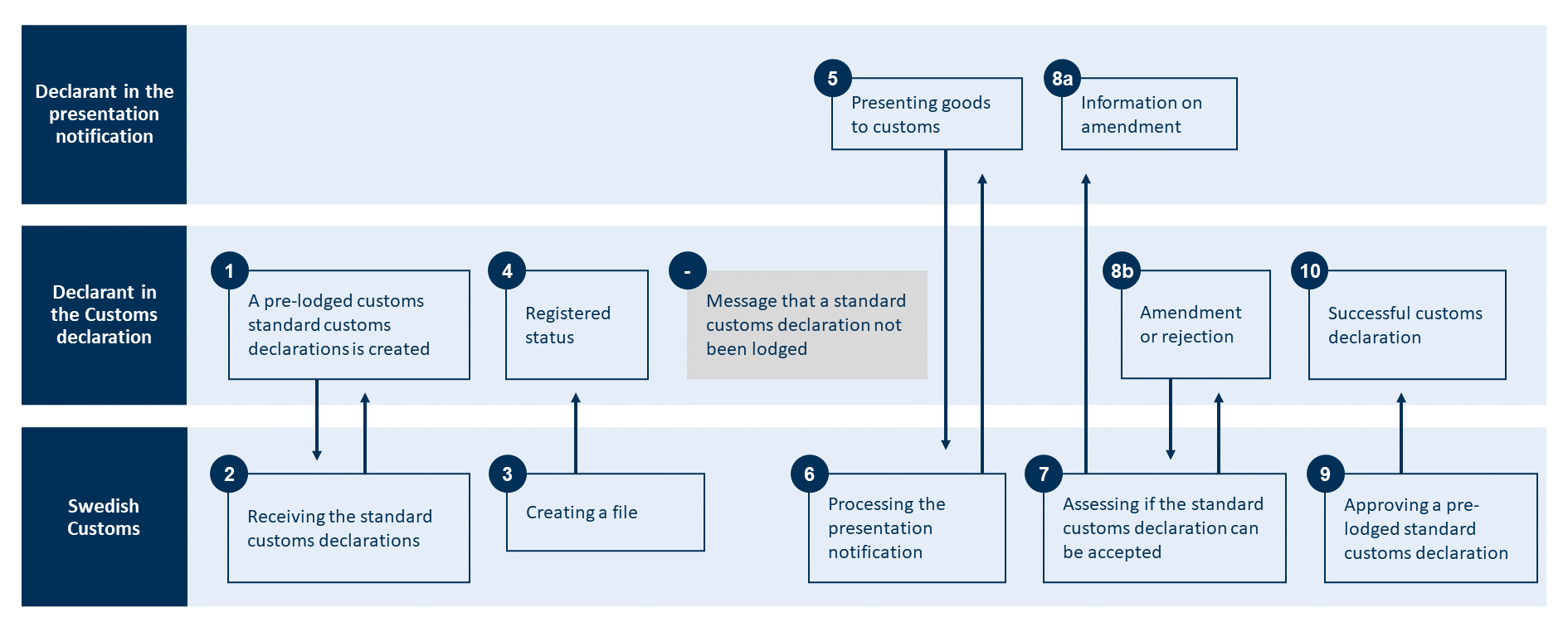
The image below describes how to pre-lodge a standard declaration. Below the image, you can read descriptions of the roles and what happens at each stage.
A description of each role can be found here:
 Zoom image
Click on the image to enlarge
Procedure description
1. A pre-lodged customs standard customs declarations is created
A customs declaration should always be submitted to Swedish Customs when goods are imported from countries outside the EU. The declarant indicated in the customs declaration draws the customs declaration and submits it digitally to Swedish Customs. The customs declaration will then contain a Local Reference Number (LRN). A declarant may also engage an representative who will handle their communications with Swedish Customs. The representative acts on behalf of the declarant.
A pre-lodged customs declaration can at the earliest be submitted 30 days prior to the arrival of your goods at the border. When pre-lodging a customs declaration, you may omit some information, which can be submitted at a later stage.
2. Receiving the standard customs declarations
Swedish Customs receives the standard customs declaration and verifies that the information is correctly entered.
- In the event of errors, the customs declaration will be stopped. A message will be sent to inform the declarant that the customs declaration cannot be processed.
- If the information is correct, a message will be sent to the declarant in the customs declaration to inform the declarant that the declaration has been received.
In the next step, the system will cross-check the information against TARIC and applicable authorisations.
- If any if these entries are incorrect, for example, if a commodity code that does not exist in TARIC is used, a message with information about the errors will be sent to the declarant in the customs declaration. The declarant will be given an opportunity to amend the errors and re-submit the customs declaration.
3. Creating a file
Swedish Customs will receive the customs declaration if the checks in (2) are approved. Swedish Customs creates a file and a 30-day deadline for presenting the goods to customs is established. The file is assigned a customs identity and the customs declaration is given ‘Registered’ status.
4. Registered status
A confirmation of receipt and customs identifier is sent to the declarant in the customs declaration. As long as the declaration has this status, it is possible to supplement information by submitting an amendment. During this step, if the information provider corrects the information in the customs declaration, a new version of the customs declarations is created and replaces the previous version.
– Message that a standard customs declaration not been lodged
If goods are not presented to customs within the established deadline, the customs declaration will no longer be considered to be Registered. The declarant will be notified via a digital message declarant in the customs declaration. The declarant in the customs declaration will then know that the presentation notification has not been received and that the declaration is not considered to be Registered.
5. Presenting goods to customs
When the goods arrive, they should be presented to Swedish Customs. The declarant in the presentation notification presents the goods to customs via a digital message or by presenting the goods directly upon arrival at the customs office.
6. Processing the presentation notification
If the goods are received by the deadline, the information is checked and linked to the customs declaration. A message confirming the receipt of the notification is sent to the declarant in the arrival notification.
In cases where the notification does not fulfil the technical requirements, it is not accepted and the arrival notification declarant is informed of this and given information on what needs to be done. Once the errors have been corrected, the declaration can be resubmitted.
If there are errors in the information, Swedish Customs will inform both the declarant in the customs declaration and the declarant in the presentation notification.
The system then performs certain checks to ensure the quality of the information provided in the declaration. If the notification fulfils the requirements, the activity Link the notification to the existing customs declaration is carried out, where a status ‘Received’ message is sent to the declarant in the presentation notification and the deadline for submitting a notification is stopped.
In cases where a declaration does not fulfil the requirements, the declarant is informed in the arrival notification of the errors found. The information provider will be given an opportunity to amend the errors and re-submit the notification.
7. Assessing if the standard customs declaration can be accepted
A check is then carried out to ensure that the information in the customs declaration is correct and that all mandatory fields are completed. If the result of the check is that the customs declaration is authorised, the case is processed further.
8a Information on amendment
If the customs declaration is not correct, the need for amendment is summarised and sent for information to the declarant in the presentation notification.
8b Amendment or rejection
If the customs declaration is not correct, the need for amendment is summarised and sent to the declarant the customs declaration. The declarant in the customs declaration is given three calender days to correct the declaration. If a correction is lodged in time, it will be processed as an amendment.
If supplementing information is necessary, a message is sent to the declarant in the customs declaration. A period of three days starts for the declarant in the customs declaration to submit an amendment. If the requested amendments are not received within three days, the customs declaration is rejected.
9. Approving a pre-lodged standard customs declaration
Swedish Customs ensures that the information in the customs declaration is correct and authorises the customs declaration.
10. Successful customs declaration
A message that the pre-lodged customs declaration is approved is sent. The process then switches to the process for standard customs declarations under step 5, ‘Processing the standard customs declaration’.