

Procedure for standard customs declaration
A customs declaration should always be submitted to Swedish Customs when goods are imported from countries outside the EU. For example, you could submit a complete standard customs declaration when the goods arrive.
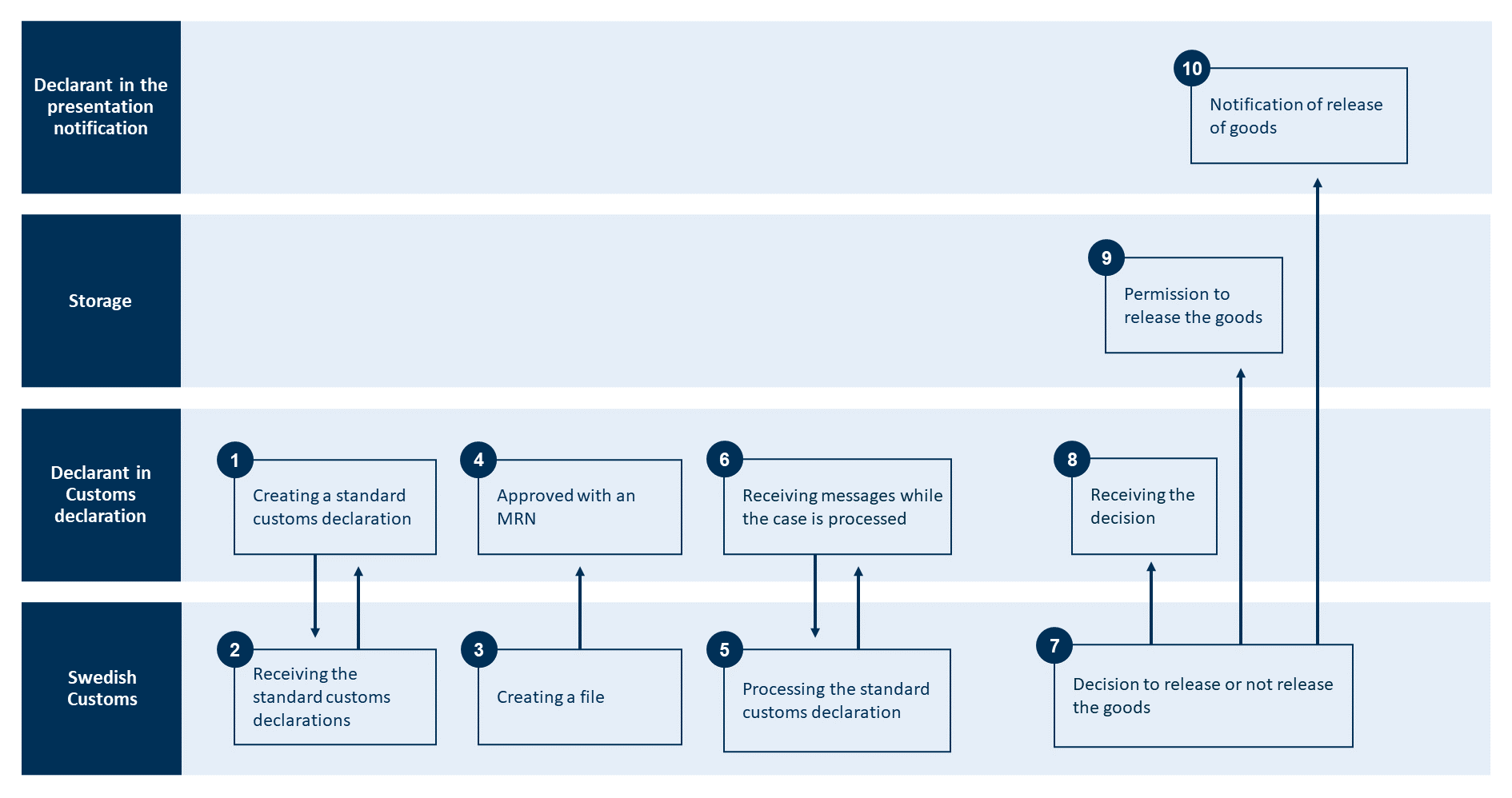
The image below describes how to lodge a standard declaration. Below the image, you can read descriptions of the roles and what happens at each stage.
A description of each role can be found here:
 Zoom image
Click on the image to enlarge
Procedure description
1. Creating a standard customs declaration
A customs declaration should always be submitted to Swedish Customs when goods are imported from countries outside the EU. The declarant in the customs declaration creates a standard customs declaration and submits it digitally to Swedish Customs. The customs declaration will then contain a Local Reference Number (LRN).
A declarant may also engage an representative who will handle their communications with Swedish Customs. The representative acts on behalf of the declarant.
2. Receiving the standard customs declarations
Swedish Customs receives the standard customs declaration and verifies that the information is correctly entered.
- In the event of errors, the customs declaration will be stopped. A message will be sent to inform the declarant that the customs declaration cannot be processed.
- If the information is correct, a message will be sent to the declarant in the customs declaration to inform the declarant that the declaration has been received.
In the next step, the system will cross-check the information against TARIC and applicable authorisations.
- If any if these entries are incorrect, for example, if a commodity code that does not exist in TARIC is used, a message will be sent in the customs declaration to inform the declarant of errors (received with errors). The declarant will be given an opportunity to amend the errors and re-submit the customs declaration.
3. Creating a file
Swedish Customs generates a file and assigns an Master Reference Number (MRN).
4. Approved with an MRN
If the check is successful, an MRN number will be assigned to the customs declaration. The declarant will be informed that the check was successful. The MRN number will be included in this message. The status Lodged and Approved will also be included in this message.
5. Processing the standard customs declaration
Swedish Customs will now verify that the information in the customs declaration is correct and can form the basis of a decision in the matter.
At this point, the declarant in the customs declaration may be required to substantiate the information provided. Supporting documents can be uploaded and submitted in Swedish Customs’ online services. If an examination of the goods is required, the declarant will be notified.
If the customs declaration is submitted in advance, the customs declaration is linked to the standard customs declaration procedure in this step.
6. Receiving messages while the case is processed
The declarant will receive any digital messages sent by Swedish Customs to request supporting documents and inform that an examination of the goods will be conducted.
Supporting documents should be submitted via Swedish Customs’ online service Uppladdning av handling (uploading documents). A link to this online service is included in the message; however, your company needs access to the online services.
Once any necessary examinations have concluded, the declarant will be notified of the outcome of the examination.
7. Decision to release or not release the goods
Swedish Customs will verify the correctness of the information in the customs declaration and decide whether or not the goods may be released.
- If the goods may be released, Swedish Customs will determine the amount of duties, VAT and other fees. The declarant will be notified of the decision.
- If Swedish Customs is considering not releasing the goods, the declarant will be notified. The declarant is given 30 days to lodge an appeal or opinion. If the declarant does not lodge an appeal that affects Swedish Customs’ position, a decision not to release the goods will be made, and the declarant will be notified.
8. Receiving the decision
The declarant receives the decision.
9. Permission to release the goods
If the goods are released, the storage owner will receive a release or removal notification. Storage owners will either receive this information by subscribing to the corresponding service, or they can find the notification via Swedish Customs’ online services.
10. Notification of release of goods
This only occurs in cases where the presentation notification and the standard customs declaration are submitted by separate parties. If the goods are released, the declarant from the presentation notification will also be notified.